ABOUT APS | APU Ritsumeikan Asia Pacific University

WHY YOU SHOULD CHOOSE ASIA PACIFIC STUDIES (APS)

  • Interdisciplinary learning focused on the Asia-Pacific region
  • Gain practical skills to tackle global challenges
  • Explore the world every day on our multicultural campus

WHAT DO YOU WANT TO KNOW ABOUT APS?

Tap the buttons below to find the information you need.

What is APS?

APS is a global learning community that equips you with the skills to understand and find solutions to the world’s complex, interconnected problems. Our three interdisciplinary areas—International Relations; Culture, Society, and Media; and Global Economy—explore the political science, sociology, and economics of the Asia Pacific region.

What is takeaway from APS?

Through interactive and hands-on learning—such as intensive discussions and field research—you will develop critical thinking skills, learn to view issues from multiple perspectives, and enhance your communication skills to effectively share your voice. In APS, these practical tools will support you as you turn insights into action and become a leader on the global stage.

AREAS OF STUDY

APS offers the following three areas of study. With a solid foundation in language proficiency and understanding of the diverse cultures, histories, societies, natural environments of the Asia Pacific region, students can develop comprehensive problem solving skills and expertise related to various issues in the region through these study areas.

  • CULTURE, SOCIETY, AND MEDIA

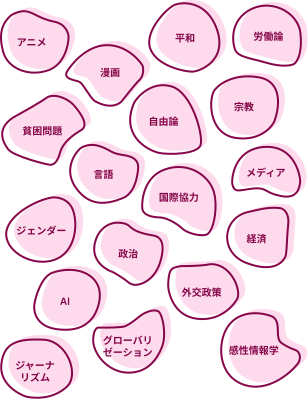
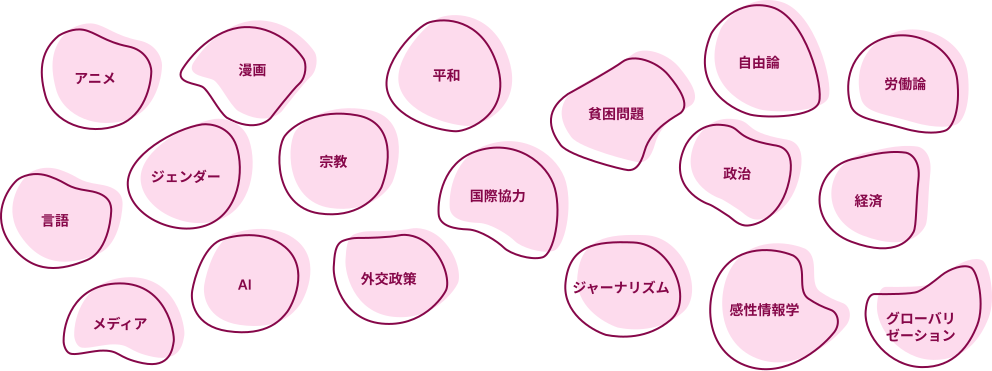
    CULTURE, SOCIETY, AND MEDIA

    Explore new ways of coexistence within our diverse global society. By bridging theories of culture, society, and media with hands-on field research, you will learn to look beyond the surface and analyze complex issues from multiple perspectives. Through this process, you will develop the creativity and critical insights needed to address societal problems and propose relevant solutions for a better world.

  • GLOBAL ECONOMY

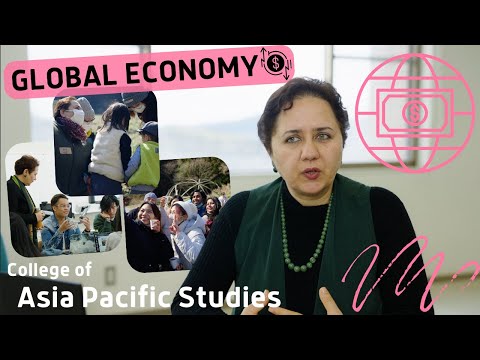
    GLOBAL ECONOMY

    From resource distribution and ecology to inequality and digitalization—economic knowledge is essential for building a sustainable future. By analyzing the behaviors of consumers, corporations, and governments, you will gain the skills and expertise to enhance social well-being and create a more prosperous world for future generations.

  • INTERNATIONAL RELATIONS

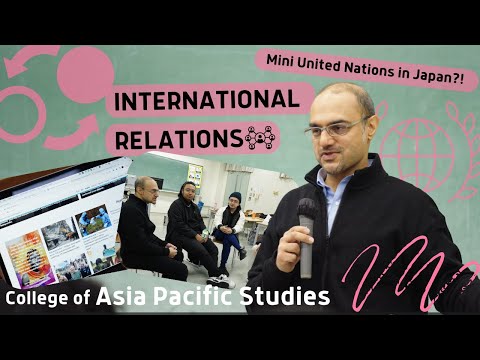
    INTERNATIONAL RELATIONS

    Examine the reality of global tensions—from rivalries between major powers to new threats facing our world. You will learn to look beyond the news, using tools from politics and law to understand why conflicts happen and how to solve them. This area prepares you with the skills and practical knowledge to take action toward peace and stability for our global society.

APS IN 90 SECONDS

HOW A STUDENT STUDIES IN APS?

In your first year, you will build a solid foundation by studying the core social sciences of our three fields: CSM, IR, and GE. From your second year, you will dive deeper into the subjects that spark your interest, leveraging the flexible curriculum to create your own unique path. By your third year, you will join a specialized seminar to sharpen your expertise, leading to a final research project in your fourth year—the culmination of your four-year journey at APS.

Tap the buttons below to find the information you need.

  • Culture, Society, and Media (CSM)
  • International Relations (IR)
  • Global Economy (GE)
  1. First Year Students
  2. Second Year Students
  3. Third Year Students
    Major Seminar
  4. Fourth Year Students
    Research Seminar

Culture, Society, and Media (CSM)

Master the Essentials: Building a Strong Social Science Foundation

required
New Social Science
  • Sociology
  • Politics
  • Economics

Connecting with others brings both joy and challenges. In our globalized world, its is essential to explore new ways to live alongside each other amid changing values and emerging technologies. In this area, you will explore how to build a more inclusive society by studying everything from the daily life of individuals to large-scale social trends. By combining theory with hands-on research, you will gain the skills to solve social problems and propose creative ideas for a better future.

Turning Your Interests into Expertise

After two years of foundation learning, you will join a seminar class that matches your academic interests. It’s the perfect class to further customize your education and complete a graduation research project representing your entire APS journey.

What is a seminar class? A seminar is a special type of interactive, small-group class (under 20 students). This class allows you to do research and work directly with professors and peers who share your same interests. Here, you'll have the chance to dive deeper into academic topics of your choosing.

Dive Deeper into Your Chosen Field through a Seminar Class

The Culmination of Four Years’ Study

required
Research Seminar II
Graduation Thesis · Graduation Report
  1. First Year Students
  2. Second Year Students
  3. Third Year Students
    Major Seminar
  4. Fourth Year Students
    Research Seminar

International Relations (IR)

Master the Essentials: Building a Strong Social Science Foundation

required
New Social Science
  • Sociology
  • Politics
  • Economics

Explore the shifting power dynamics of the Asia Pacific and Indian Ocean regions. As economic growth and political tensions fluctuate, you will analyze the real-world conflicts between major powers and the emerging threats that challenge our global stability. In this area, you will move beyond textbooks to understand the reality of global anxieties and develop the practical insights needed to navigate a world of constant change.

Turning Your Interests into Expertise

After two years of foundation learning, you will join a seminar class that matches your academic interests. It’s the perfect class to further customize your education and complete a graduation research project representing your entire APS journey.

What is a seminar class? A seminar is a special type of interactive, small-group class (under 20 students). This class allows you to do research and work directly with professors and peers who share your same interests. Here, you'll have the chance to dive deeper into academic topics of your choosing.

Dive Deeper into Your Chosen Field through a Seminar Class

The Culmination of Four Years’ Study

required
Research Seminar II
Graduation Thesis · Graduation Report
  1. First Year Students
  2. Second Year Students
  3. Third Year Students
    Major Seminar
  4. Fourth Year Students
    Research Seminar

Global Economy (GE)

Master the Essentials: Building a Strong Social Science Foundation

required
New Social Science
  • Sociology
  • Politics
  • Economics

To build a world where societies can truly thrive across generations, we must understand how natural resources and ecology form the very foundation of our economy. You will explore how individual and business choices, as well as government policies, shape the quality of our lives. By connecting these different levels, you will develop the insight to turn global challenges into opportunities for a more prosperous and balanced future.

Turning Your Interests into Expertise

After two years of foundation learning, you will join a seminar class that matches your academic interests. It’s the perfect class to further customize your education and complete a graduation research project representing your entire APS journey.

What is a seminar class? A seminar is a special type of interactive, small-group class (under 20 students). This class allows you to do research and work directly with professors and peers who share your same interests. Here, you'll have the chance to dive deeper into academic topics of your choosing.

Dive Deeper into Your Chosen Field through a Seminar Class

The Culmination of Four Years’ Study

required
Research Seminar II
Graduation Thesis · Graduation Report

APS VIDEOS

  • What Should You Study in Japan? Culture, Society, and Media
    March 24, 2023

    What Should You Study in Japan? Culture, Society, and Media

    APU Ritsumeikan Asia Pacific University Ritsumeikan APU International Admissions (Japan)
    PLAY
  • What Should You Study in Japan? International Relations
    March 16, 2023

    What Should You Study in Japan? International Relations

    APU Ritsumeikan Asia Pacific University Ritsumeikan APU International Admissions (Japan)
    PLAY
  • What should you study in Japan? Global Economy
    May 26, 2023

    What should you study in Japan? Global Economy

    APU Ritsumeikan Asia Pacific University Ritsumeikan APU International Admissions (Japan)
    PLAY

APS SUBJECT LIST

Find a course for you!

APS SUBJECTS

Culture, Society and Media

  • Sociology
  • Transnational Sociology
  • Advanced Sociology
  • Social Theory
  • Social Stratification
  • Religion and Society
  • Education and Society
  • Language and Society
  • Environment and Society
  • Food System and Society
  • Global Poverty
  • Globalization and Regionalism
  • Ethnicity and the Nation State
  • Multiculturalism and Society
  • Identity and Politics
  • Gender Studies
  • Cultural Anthropology
  • Cultural Studies
  • Media and Culture
  • Media and Law
  • Media and History
  • Media and Politics
  • Media and Conflict
  • Digital Technology and Society
  • New Media and Society
  • Global History
  • A World History of Interaction
  • Political Theory
  • Human Rights
  • Peace Studies
  • The Humanities and Modernity
  • Social Psychology
  • Big Data Analysis

Global Economy

  • CComparative Political Economy of the Asia Pacific
  • Asian Economy
  • American Economy
  • Analysis of Global Economy
  • European Economy
  • Japanese Economy
  • Development Economics
  • Environmental Economics
  • International Economics
  • International Political Economy
  • International Cooperation
  • Global Poverty
  • Food System and Society
  • Environmental Communication
  • Agriculture and Resources
  • Cultural Anthropology
  • Social Stratification
  • Transnational Sociology
  • International Organizations
  • Politics of Development
  • Conflict and Development
  • Environment and Society
  • Industrial Ecology
  • Energy Management
  • Project Management
  • Microeconomics
  • Macroeconomics
  • International Finance
  • Econometrics
  • Behavioral Economics and Experimental Economics
  • Global Health Economics
  • Game Theory
  • Public Policy
  • Big Data Analysis
  • Special Lecture (Economic Issues in Asia, Middle East & Africa)

International Relations

  • International Relations Theory
  • International Cooperation
  • Human Rights
  • Political Theory
  • Politics of Development
  • Comparative Political Economy of the Asia Pacific
  • History of International Politics
  • International Law
  • Global Issues and Policies
  • Conflict and Development
  • Peace Studies
  • Globalization and Regionalism
  • International Relations in the Asia Pacific
  • International Organizations
  • Public Policy
  • International Political Economy
  • Identity and Politics
  • Geo-Politics and Post Cold War Conflicts
  • Violence and Terrorism
  • Globalization and Law
  • International Conflict Resolution
  • Foreign Policy of Japan
  • Strategic Decision Making
  • Ethnicity and the Nation State
  • Media and Politics
  • Media and Conflict

Core Subjects, APS Common Subejects A B

  • Special Lecture (Asia Pacific Studies)
  • APS Field Study
  • Introduction to Area Studies
  • Area Studies
  • Advanced Area Studies
  • Field Research Project

Seminar Subjects

  • Introduction to Research in Asia Pacific Studies
  • Research Method
  • Major Seminar
  • Graduation Research I
  • Graduation Research II
  • Graduation Thesis

COMMON LIBERAL ARTS SUBJECTS

APU Literacy

  • Student Success Workshop
  • Multicultural Cooperative Workshop
  • Peace, Humanity and Democracy
  • Introduction to Intercultural Communication
  • Intercultural Fieldwork I–II
  • Studies of Multicultural Comparison
  • Foundation for Global Leadership
  • Overseas Learning Design
  • Bridge Program
  • Languages of the Asia Pacific
  • Religions of the Asia Pacific
  • Geography of the Asia Pacific
  • Culture and Society of the Asia Pacific
  • History of the Asia Pacific
  • Japanese Politics and Society
  • Popular Culture of Japan
  • Japanese History
  • Constitution of Japan
  • Special Lecture (Japanese Studies)
  • Applied Intercultural Communication
  • Skills and Practices for Global Leadership
  • Global Leadership for Social Impact
  • Japanese Art of Tea Ceremony
  • Japanese Art of Flower Arrangement
  • Traditional Japanese Arts

Introduction to Major Studies Group

  • Introduction to Sustainable Development
  • Introduction to Tourism and Hospitality
  • Introduction to Policy Studies
  • Introduction to Sociology
  • Introduction to Culture and Society
  • Introduction to Media Studies
  • Introduction to International Relations
  • Introduction to Comparative Politics
  • Introduction to Political Science
  • World Economy and Global Issues
  • Introduction to Economics
  • Fundamental Mathematics
  • Statistics
  • Statistics for Social Sciences
  • Advanced Mathematics

Global Citizens Foundation

  • Legal Studies
  • Psychology
  • Bioethics
  • AI and Society
  • Western Philosophy
  • Chinese Philosophy
  • Western Visual Arts
  • Modern Science and Technology
  • Negotiation Skills
  • Logic and Critical Thinking
  • Self‐analysis for Career Design
  • Diverse Perspectives on Understanding Careers
  • Special Lecture (Liberal Arts Subject)
  • Web Design
  • Information Processing Essentials
  • Programming Essentials
  • Information Literacy
  • Health Science
  • Media Production Lab
  • Internship
  • Career Field Analysis for Career Development
  • AI and Data Science
  • Introduction to GIS
  • Database Systems
  • Special Lecture (ICT)
  • Information Systems Programming

LANGUAGE EDUCATION SUBJECTS

Japanese Language Classes

  • Japanese Course (Foundation/Intermediate/Pre-Advanced/Advanced)
  • Career Japanese
  • Language and Culture in Japan
  • Language and Social Topics in Japan
  • Kanji and Vocabulary Skills
  • Japanese for Self-expression
  • Japanese Communication Skills

English Language Classes

  • English Course (Foundation/Pre-Intermediate/Intermediate/Upper-Intermediate/Advanced)
  • English for Discussion and Debate
  • English of the Media
  • English for Journalism
  • English for Business A
  • English for Hospitality and Tourism
  • English Communication Skills
  • English for Business B
  • Reading Fiction in English

Asia Pacific Language Classes

  • Chinese I – III, Global Language Learning
  • Korean I – III, Global Language Learning
  • Malay/Indonesian I – III、, Global Language Learning
  • Spanish I – III, Global Language Learning
  • Thai I – III, Global Language Learning
  • Vietnamese I – III, Global Language Learning

Specific Language Classes

  • English Proficiency Test Preparation Course I – III
  • TESOL
  • Japanese Linguistics for Japanese Language Education
  • Japanese Language Teaching
  • Introduction to Asia Pacific Languages
  • Intensive Language Learning
  • Special Lecture (Language Education Subject)

STAY CONNECTED WITH APS FOR THE LATEST UPDATES.

Stay up to date with the latest news, events, and stories from APS. Sign up to receive updates on programs, student life, and upcoming opportunities.

Request Information
Select Your Language
CLOSE

Please set your preferred language by selecting the relevant value from the list below.

Learn more about APS
CLOSE
Loading...
PAGE TOP